

When a critical production die fails, and the original manufacturer no longer produces that model, manufacturers face a crisis. Discontinued dies create impossible situations—production stops, replacement seems impossible, and finding alternatives requires complete line redesigns. Reverse engineering transforms this nightmare scenario into a manageable solution.
The Discontinued Die Dilemma
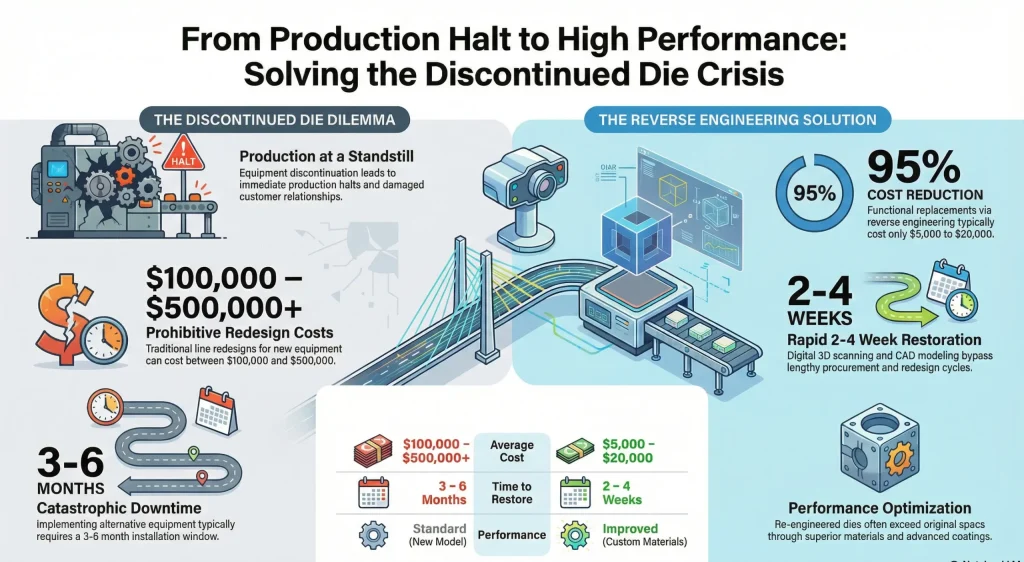
Equipment discontinuation happens frequently in manufacturing. Companies merge, product lines end, or older models become unsupported. When the dies running your production line fall into this category, the consequences escalate quickly:
- Production halts with no replacement available
- Entire line redesigns costing hundreds of thousands
- Lost production capacity affecting delivery commitments
- Customer relationships are damaged by the inability to fulfil orders
- Emergency sourcing at premium prices with uncertain results
Traditional solutions—such as finding used equipment, modifying production processes, or complete line replacements—all involve substantial costs and extended downtime.
Reverse Engineering: The Precision Solution
Reverse engineering provides a remarkable alternative. This process analyzes existing dies—even damaged ones—to create exact replicas or improved versions that maintain compatibility with existing production equipment.
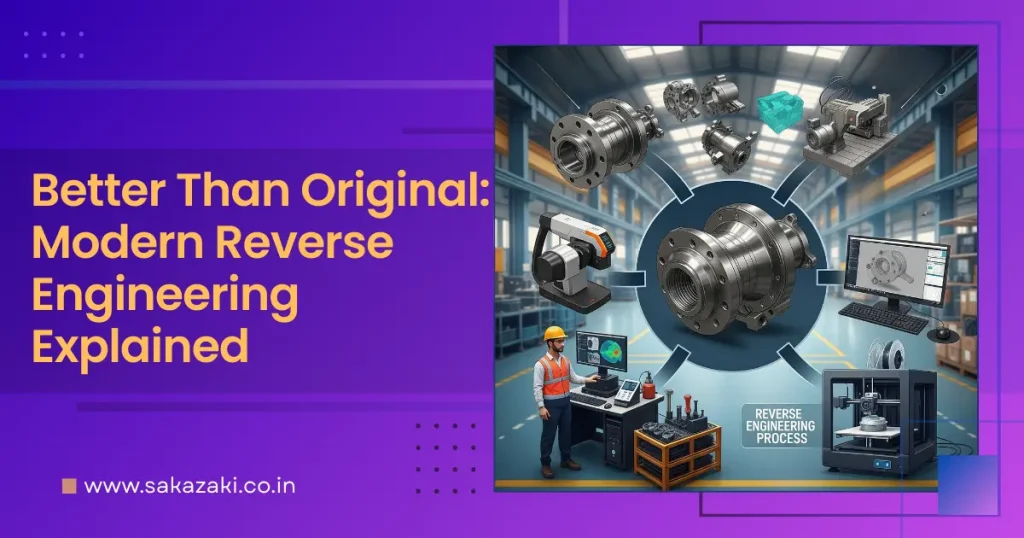
The Reverse Engineering Process:
- 3D scanning technology captures precise dimensions
- Material analysis identifying composition and properties
- Performance assessment understanding operational requirements
- CAD modelling creates detailed digital specifications
- Prototype validation ensuring perfect compatibility
This systematic approach recreates discontinued dies with modern manufacturing precision, often exceeding original specifications.
Beyond Simple Replication
Modern reverse engineering doesn’t just copy—it improves. While maintaining critical dimensions for equipment compatibility, engineers can enhance performance through:
- Superior materials offering longer operational life
- Advanced coatings reduce friction and wear
- Optimized geometries improving cutting efficiency
- Modern heat treatment enhances durability
- Quality improvements addressing original design weaknesses
The result? Replacement dies that fit existing equipment perfectly while delivering better performance than originals.
Speed Advantage in Critical Situations
When production stops due to a die failure, every hour costs money. Reverse engineering provides a rapid response compared to alternatives:
Reverse Engineering Timeline: 2-4 weeks from damaged die to functional replacement
Alternative Timeline: 3-6 months for line redesign and new equipment installation
This speed advantage often makes the difference between manageable disruption and catastrophic business impact.
Cost-Effectiveness That Protects Your Investment
Complete line replacement for discontinued die compatibility can cost more. Reverse engineering typically delivers functional replacements for 90-95% cost savings while maintaining production capability.
Financial Impact:
- Capital preservation, avoiding massive equipment investments
- Faster ROI through rapid production restoration
- Inventory protection, maintaining product line viability
- Customer retention meeting: delivery commitments
- Competitive advantage through uninterrupted production
Intellectual Property and Legal Compliance
Professional reverse engineering operates within legal frameworks, focusing on:
- Functional replication, not trademark infringement
- Independent creation from physical analysis
- Performance matching for equipment compatibility
- Patent-expired technology or legitimate replacement needs
Documentation for Future Security
Reverse engineering projects create valuable documentation:
- Complete CAD specifications for future reproduction
- Material specifications ensuring consistency
- Manufacturing parameters maintaining quality
- Performance benchmarks validating results
This documentation provides insurance against future discontinuation challenges.
Real-World Applications
Reverse engineering solves discontinued die challenges across industries:
Hygiene Products: Maintaining sanitary napkin production with obsolete dies
Medical Devices: Ensuring surgical mask manufacturing continuity
Food Packaging: Preserving food safety compliance with legacy equipment
Electronics: Supporting component production despite discontinued tooling
The Strategic Advantage
Manufacturers leveraging reverse engineering gain strategic flexibility. Rather than being hostage to equipment availability, they control their production destiny through technical capability and engineering expertise.
Don’t let discontinued dies shut down your production. Sakazaki’s reverse engineering specialists combine advanced 3D scanning technology with precision manufacturing expertise to recreate discontinued dies with improved performance—often within weeks of initial consultation.