


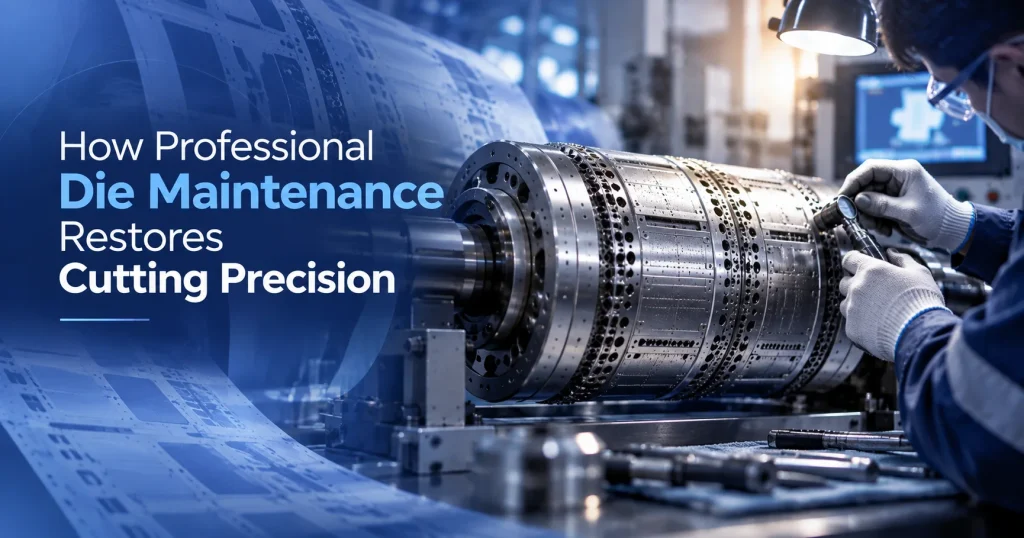
Cutting precision deteriorates gradually, often unnoticed until quality problems surface across production lines. While every industry depends on exact tolerances, the path back to peak performance isn’t replacement—it’s professional die maintenance. Understanding how expert restoration works reveals why maintenance has become essential across diverse manufacturing sectors.
Why Precision Loss Often Goes Undetected
One of the most overlooked insights in manufacturing is that precision decay is nonlinear. A die doesn’t wear at a steady, predictable rate—it typically shows a slow initial decline, followed by an accelerating drop-off once it crosses a critical wear threshold. This is why manufacturers relying on fixed maintenance calendars (e.g., “sharpen every six months”) often get caught off guard.
Why Fixed Schedules Fail:
- Production volume variations shift actual cycle counts dramatically
- Material hardness differences accelerate wear unevenly across product lines
- Seasonal humidity and temperature shifts affect coating and material stability
- Operator handling differences across shifts introduce inconsistent stress
- Undetected micro-damage from foreign material contamination speeds decline
The insight here: condition-based maintenance, triggered by actual performance data rather than the calendar, consistently outperforms fixed-interval servicing in extending die life.
Restoration Through Precision Sharpening
Professional sharpening differs fundamentally from basic grinding. Advanced techniques restore original geometries while optimizing cutting performance through laser-guided precision and controlled material removal—maintaining exact specifications rather than simply removing dull material.
A key technical insight often missed: improper sharpening can accelerate future wear. Removing too much material to “fix” a problem shortens the die’s remaining service life. It can throw off the balance of rotary dies, creating vibration-induced wear that compounds over time. That is why the technician’s skill matters as much as the equipment.
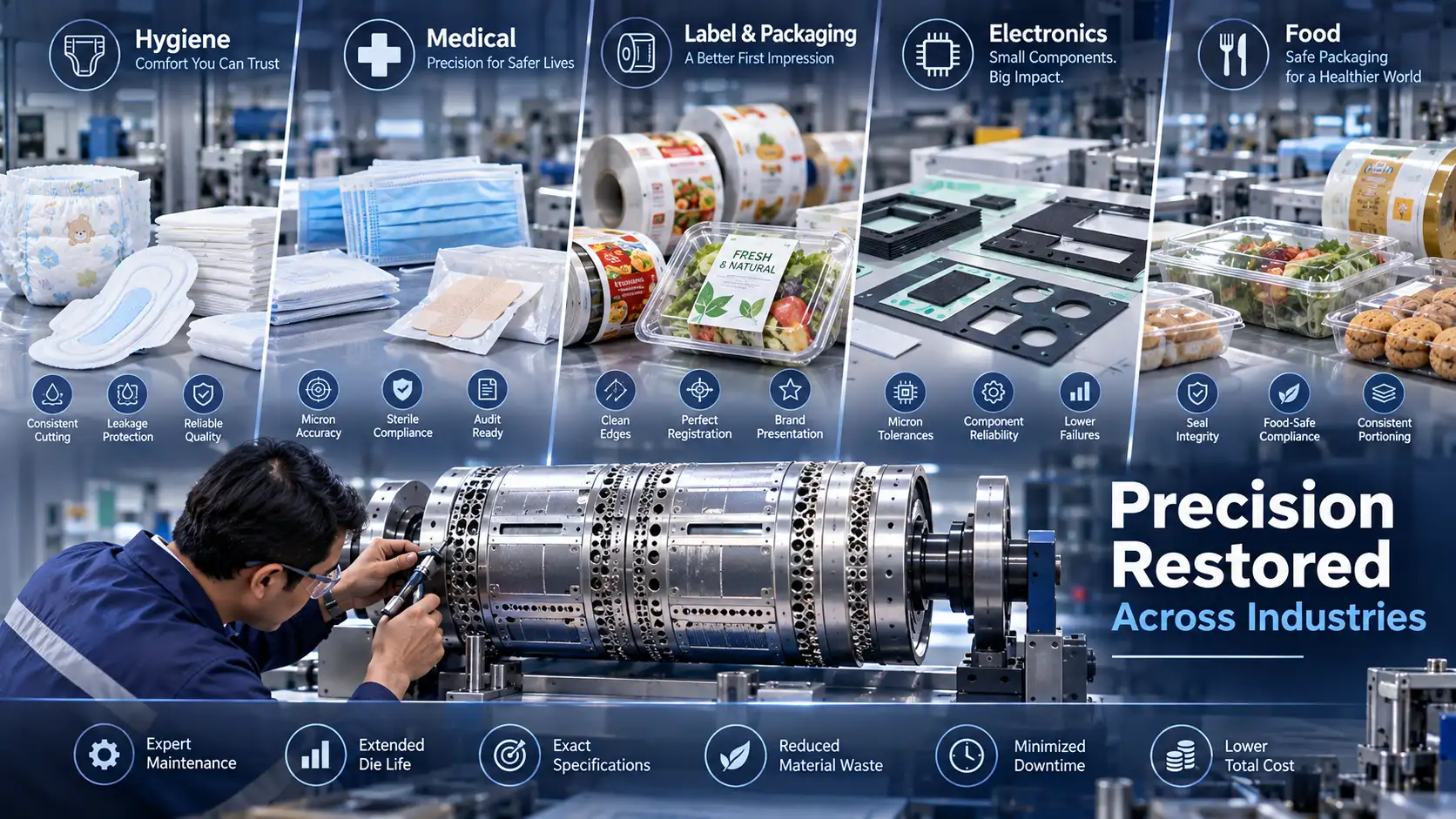
Hygiene Industry: Restoring Consistency for Critical Products
Sanitary napkins, diapers, and hygiene industry essentials demand absolute cutting consistency. Even minor precision loss creates leakage risks and quality inconsistencies that damage brand reputation.
Professional maintenance restores the exact channel depths, sealing edges, and core-cutting precision these products require, ensuring every unit meets stringent quality standards regardless of production volume. An underappreciated factor here: hygiene product lines often run multiple dies in tandem (core cutters, sealing rollers, channel rollers working together), so precision loss in just one component can create compounding misalignment across the entire assembly—making synchronized maintenance scheduling across all die stations critical.
Medical Industry: Precision Where Safety Cannot Compromise
Medical device manufacturing operates under zero-tolerance quality standards. Bandages, surgical masks, and sterile packaging require microscopic accuracy to maintain seal integrity and regulatory compliance.
Medical Maintenance Priorities:
- Contamination-free restoration processes
- Verified dimensional accuracy meeting regulatory documentation
- Sterile-compatible materials throughout servicing
- Traceable maintenance records supporting audit requirements
A critical insight for this sector: maintenance documentation is as valuable as the maintenance itself. Regulatory audits increasingly require manufacturers to prove equipment was maintained within validated parameters—meaning a maintenance partner who provides detailed before/after measurement reports isn’t offering a bonus service, but a compliance necessity.
Label & Packaging: Precision for Perfect Presentation
Packaging and labelling applications depend on perfect registration and clean edges for professional appearance. Worn dies produce ragged edges and misaligned cuts that undermine brand presentation.
Restoration restores the crisp, precise cutting essential for labels, wrappers, and packaging that represent brands on retail shelves worldwide. Interestingly, this is also the segment with the least forgiving customer feedback loop: a misaligned label or torn wrapper is immediately visible to end consumers, unlike internal component tolerances that may only surface as functional failures later. This visibility factor often justifies more frequent maintenance cycles than the underlying wear alone would suggest.
Electronics Industry: Micro-Precision Restoration
Electronic component manufacturing—gaskets, adhesives, and insulation materials—requires micron-level tolerances. Even minimal wear compromises component fit and functionality.
Professional maintenance restores the exacting precision electronics manufacturing demands, preventing costly downstream assembly failures caused by imprecise components. A notable insight: in electronics, a single imprecise gasket or insulation cut can cause failures that only appear after final assembly—meaning the true cost of precision loss is often invisible at the cutting stage and only surfaces as expensive warranty claims or field failures weeks later.
Food Industry: Hygienic Precision Restoration
Food packaging and processing dies require restoration that maintains both cutting accuracy and food-safe compliance. Professional maintenance addresses:
- Seal integrity restoration preventing contamination pathways
- Food-grade material compliance throughout servicing
- Clean, burr-free edges eliminating particle generation
- Consistent portion accuracy for packaging applications
A key operational insight: food industry dies face accelerated wear cycles because high-speed production demands meet variable product moisture content. As a result, maintenance intervals often need to be shorter and more frequent than in other sectors—even when visible wear appears minimal.
The Maintenance Advantage Across Industries
Regardless of application, professional die maintenance delivers consistent value:
- Extended operational lifespan by 100-200% compared to reactive approaches
- Restored dimensional accuracy matching original specifications
- Reduced material waste from precision cutting restoration
- Lower total cost than premature replacement
- Minimized production downtime through scheduled servicing
Precision as a Continuous Commitment
Cutting precision isn’t a one-time achievement—it requires ongoing attention throughout a die’s operational life. Manufacturers across hygiene, medical, packaging, electronics, and food sectors who prioritize professional maintenance consistently outperform those relying on reactive replacement strategies.
Investing in expert restoration pays dividends through consistent quality, extended equipment life, and protected production schedules—advantages that compound across every industry that depends on precision cutting technology.
Restore your dies to peak cutting precision with expert care. Sakazaki’s professional maintenance services combine century-old craftsmanship with modern restoration techniques, delivering the precision your industry demands across every application.
Restore Your Cutting Precision Today
Don’t let gradual wear compromise your production quality. Schedule a professional precision assessment and discover how expert maintenance can bring your dies back to peak performance.