


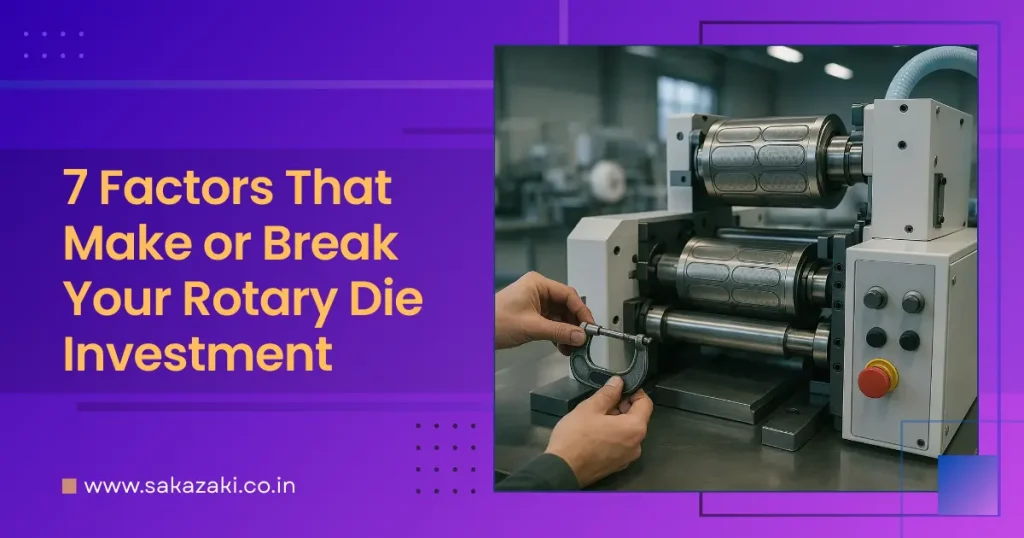
Investing in industrial rotary dies represents a significant capital commitment for manufacturers. While quality dies can deliver 5-10 years of reliable service, achieving this lifespan isn’t guaranteed. Understanding the critical factors that influence die longevity empowers you to maximize return on investment and maintain consistent production quality.
1. Material Quality and Composition
The foundation of die longevity starts with raw material selection. Premium-grade tool steels with precise carbon, chromium, and vanadium content offer superior wear resistance compared to standard materials. High-quality dies manufactured from hardened tool steel maintain cutting-edge integrity through millions of cycles, while inferior materials deteriorate rapidly under production stress.
Material quality impacts:
- Edge retention and sharpness consistency
- Resistance to thermal degradation
- Corrosion and oxidation protection
- Overall structural integrity
2. Heat Treatment and Hardening Processes
Proper heat treatment protocols transform good steel into exceptional cutting tools. Precision-controlled hardening, tempering, and stress-relief processes create optimal hardness levels (typically 58-62 HRC) while maintaining toughness. Dies with inadequate heat treatment may appear identical but fail prematurely under operational loads.
3. Operating Speed and Production Volume
Higher production speeds generate greater friction and heat, accelerating wear. Dies running at 200 meters per minute experience dramatically different stress compared to those at 50 meters per minute. Understanding your operational parameters allows proper die specification and realistic lifespan expectations.
Speed considerations:
- Heat generation and thermal cycling effects
- Cutting force magnitude and frequency
- Material friction coefficients
- Cooling system effectiveness
4. Substrate Material Characteristics
The materials you’re cutting directly impact die wear rates. Abrasive substrates, such as those containing fillers, adhesives, or coatings, create higher friction than clean paper or films. Similarly, materials with inconsistent thickness or density cause uneven loading, thereby accelerating localized wear.
5. Maintenance Practices and Resharpening Frequency
Perhaps the most controllable factor is preventive maintenance. Regular inspection, cleaning, and timely resharpening extend die life exponentially. Dies maintained through scheduled resharpening programs can achieve 2-3 times the service life of neglected counterparts. Waiting until cutting quality degrades significantly reduces the total number of resharpening cycles available.
6. Operating Environment Conditions
Environmental factors often receive insufficient attention but significantly impact longevity:
- Temperature fluctuations cause thermal expansion stress
- Humidity levels affecting corrosion rates
- Contamination exposure from dust or debris
- Storage conditions during production downtime
7. Initial Manufacturing Precision
Dies produced with advanced CNC machining and precision grinding exhibit superior dimensional consistency and balance. This manufacturing quality directly influences operational smoothness, reducing vibration-induced stress and premature wear. Tight tolerances in initial production translate to extended field performance.
Maximizing Your Investment
Understanding these interconnected factors allows manufacturers to make informed decisions about die selection, operational parameters, and maintenance scheduling. While some factors, such as substrate characteristics, may be fixed, optimizing controllable variables can dramatically extend service life.
Strategic approaches include:
- Selecting dies engineered for your specific application
- Implementing preventive maintenance schedules
- Monitoring performance metrics for early intervention
- Partnering with manufacturers offering resharpening services
The difference between a 3-year die life and a 10-year die life often comes down to informed decision-making and proactive management. When precision manufacturing meets strategic maintenance, rotary dies deliver exceptional long-term value.
For manufacturers committed to maximizing die longevity and production efficiency, Sakazaki provides precision-engineered rotary dies backed by comprehensive technical support and professional resharpening services that extend operational life.