


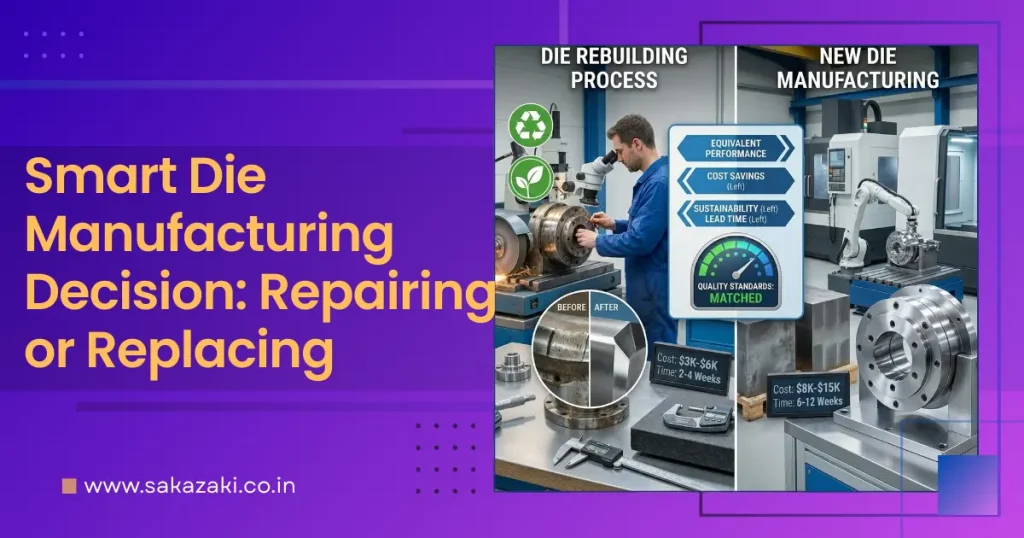
When a rotary die shows signs of wear, manufacturers face a critical decision: invest in a brand-new replacement or rebuild the existing die? This choice significantly impacts both operational budgets and production timelines. Understanding the true comparison between these options can save your company substantial resources while maintaining peak manufacturing performance.
The Cost Reality: Beyond the Price Tag
The most immediate difference appears in upfront costs. Professional die rebuilding typically costs 40-70% less than purchasing new dies—a compelling advantage that captures immediate attention.
Cost Comparison Breakdown:
| Factor | New Dies | Rebuilt Dies |
|---|---|---|
| Material Costs | 100% new materials | Reuses base structure |
| Manufacturing Time | Complete fabrication | Focused restoration |
| Typical Investment | $8,000 – $15,000+ | $3,000 – $6,000 |
| Lead Time | 6–12 weeks | 2–4 weeks |
| Performance | New baseline | Restored to original specs |
Performance: The Quality Question
Many manufacturers assume “new must be better”—but this assumption doesn’t reflect modern rebuilding capabilities. Professional die rebuilding restores dies to original equipment specifications, often exceeding the performance of worn “new” dies from lesser manufacturers.
Rebuilt Die Performance Advantages:
- Precision re-grinding to exact original tolerances
- New cutting-edge geometry with laser-sharpened finish
- Enhanced surface treatments with modern coating technologies
- Structural integrity verification, ensuring reliability
- Performance testing confirming specification compliance
Expert rebuilding doesn’t simply patch problems—it systematically restores every critical component to peak performance standards.
Speed to Production: Time as Currency
In manufacturing, downtime equals lost revenue. New die manufacturing requires complete fabrication from raw materials through final testing—a process spanning 6-12 weeks or longer for complex designs.
Die rebuilding leverages the existing structure, focusing restoration efforts on worn components. This targeted approach typically delivers fully functional dies in 2-4 weeks—often 3x faster than new die manufacturing.
For production lines dependent on specific die configurations, this time advantage can prevent costly production interruptions and maintain delivery commitments to customers.
Environmental Responsibility and Sustainability
Modern manufacturing increasingly prioritizes environmental impact. Rebuilding embodies circular-economy principles by extending equipment lifespans and reducing waste.
Sustainability Benefits:
- Reduced raw material consumption, preserving natural resources
- Lower energy requirements compared to complete manufacturing
- Minimized waste generation through targeted restoration
- An extended equipment lifecycle is delaying disposal
- Smaller carbon footprint throughout the process
Companies with sustainability commitments find that rebuilding aligns perfectly with environmental goals while delivering economic benefits.
When New Dies Make Sense
Die rebuilding isn’t always the optimal choice. New dies are preferable when:
- Design modifications are needed for product changes
- Technology upgrades require different die configurations
- Severe structural damage compromises base integrity
- Material incompatibility exists with current applications
- Original specifications no longer meet production requirements
The Hybrid Strategy: Maximizing Value
The most sophisticated manufacturers employ a strategic approach combining both options:
Rebuild for: Regular wear, cutting-edge degradation, minor damage, standard production continuation.
Buy new for: Design changes, capacity expansion, technology upgrades, catastrophic failures.
This balanced strategy optimizes capital allocation while maintaining production flexibility.
Quality Assurance: The Critical Differentiator
The rebuilding vs. new comparison ultimately depends on rebuild quality. Amateur rebuilding attempts deliver disappointing results, reinforcing the “new is better” misconception.
Professional die rebuilding requires:
- Specialized grinding equipment with precision controls
- Material science expertise for proper restoration techniques
- Quality verification processes ensuring specification compliance
- Comprehensive testing protocols validating performance
- Experienced technicians understand die engineering
Making the Right Decision
Evaluate your specific situation, considering:
Financial factors: Budget constraints, total cost of ownership, cash flow impact
Timeline requirements: Production schedules, customer commitments, inventory levels
Performance needs: Quality standards, tolerance specifications, production volumes.
Strategic goals: Sustainability objectives, capacity planning, technology roadmap
The Verdict: Smart Economics
For most situations, professional die rebuilding delivers exceptional value—preserving 40-70% of capital while maintaining performance standards and accelerating return to production. The key lies in partnering with rebuilding specialists who possess the expertise, equipment, and commitment to quality to deliver results.
Transform worn dies into like-new assets while protecting your capital investment. Sakazaki’s comprehensive die rebuilding services combine century-old precision craftsmanship with advanced restoration technology, delivering performance that matches new dies at a fraction of the cost.